

What does human-grade mean? Why most of the pet aisle can't say it
Human-grade means human food rules from farm to finished product. Why most of the pet aisle can't say it, for dogs or cats, and how to read a label in seconds.
The short answer
Human-grade means every ingredient and the finished product are stored, handled and made under the same rules as food for people, in a facility licensed to make human food. Most dog and cat food can't claim it, because once a pet food maker buys an ingredient, it stops counting as human food.
Rigby is human-grade from farm to pouch, for dogs and cats, with every ingredient printed in full.
You're in the pet store, standing in front of a wall of bags, tins, tubes and chews. Dog on one side, cat on the other, and every one of them is shouting. Natural. Premium. Wholesome. Real. One of them, in a font that means business, says human-grade.
You've been there long enough for someone in an apron to ask if you need a hand. You don't. You need a translator.
So here's the translation, starting with the word that sounds the most impressive and gets used the least.
What human-grade actually means.
Human-grade means every ingredient, and the finished product itself, is stored, handled, processed and transported under the same rules as food for people, and made somewhere licensed to make human food. Farm to finished product. If one step leaves the human food chain, the claim goes with it. It means the same thing on a bag of dog food as on a tin for a cat.
There's a small irony here. The term human-grade is only ever used for pet food. Food for people is simply called edible. Nobody prints "human-grade" on a carton of eggs. They don't need to.
Why most of the aisle can't say it.
Most of what's on that wall is made in pet food plants, under the rules for animal food. And here's the part the bags don't mention: once a pet food maker buys an ingredient, it stops counting as edible, whatever it was when it left the farm. Same chicken. Different rules. Different destination.
That's why pet labels carry words you'll never see at a grocery store. Meat by-products. Poultry meal. Animal digest. Natural flavor. They're legal and they're common, in dog food and cat food alike. They're also a category of food you can only buy for your pet.
Watch for the near-miss, too. "Made with human-grade ingredients" sounds the same and isn't. It tells you where some of the ingredients started. It says nothing about what happened to them after that.
The grocery-store test.
The badge on the front is a start. The answer is on the back. Turn the bag or the tin over, read the panel, and ask one question of every line: could I buy this at a good grocery store, under this name?
- Pass. Organic chicken. Organic butternut squash. Organic peas. Organic olive oil. Wild-caught cod. You know which aisle each one lives in.
- Ask what it is. Names that describe a category rather than a food. If it only exists on a pet label, ask why it's there.
- Ask who it's for. Gums, glycerin, preservatives, added flavors. They're there to keep a product on the shelf longer or make it cheaper to produce. They're working for the factory, not for your pet.
Why bother? Because whatever's in it goes in the bowl every day. Feed twice a day and that's 730 meals a year, whether the bowl belongs to a dog or a cat. Worth knowing exactly what they are.

How Rigby is made.
We think a dog is family. A cat is family. And family doesn't get the compromise version.
So Rigby is human-grade from farm to pouch, for dogs and cats. Every ingredient is human food, the kind you'd find in the produce, meat and fish aisles of the best grocery store near you, and it stays human food all the way into the pouch. No step leaves the human food chain. Not one.
Here's the whole Free-Range Chicken recipe for dogs. Not the highlights. All of it:
That's everything
Organic butternut squash, organic chicken, organic peas, water, organic extra virgin olive oil. 78 calories a pouch.
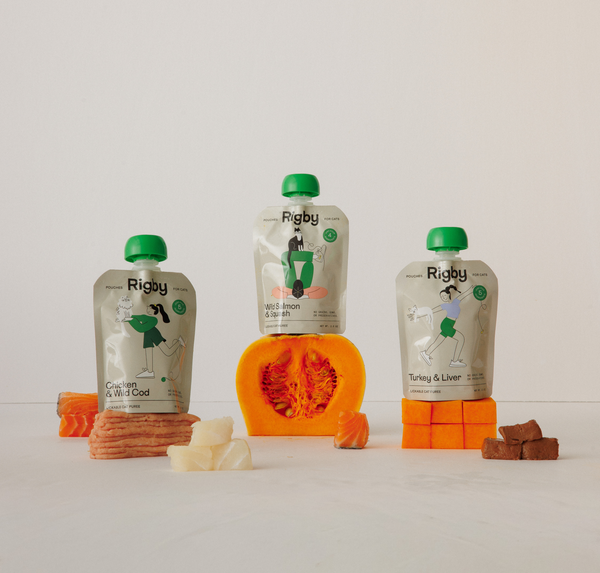
And here's Chicken & Wild Cod for cats:
That is the whole recipe
Water, organic chicken, wild-caught cod, organic pumpkin, organic tapioca starch. 50 calories a pouch.
It took us three years to get the first Rigby pouch right. There was a quicker way: add preservatives and fillers, make it in a pet food plant, and you can make a pouch faster and cheaper. You also make a worse one. So we said no to all of it.
That's the standard across the range. Rigby Essential Pouches for dogs are four real ingredients or fewer, with no gums, no fillers and nothing artificial. Rigby Cat Essential Pouches are five ingredients or fewer, printed in full, with no grains, gums or preservatives. Certified organic where the recipe allows, wild-caught where it doesn't. Made in the USA.
Squeeze as much as you see fit.
When the food is this good, you don't need to ration it. Rigby goes on top of whatever is already in the bowl, or straight from the spout.
- For dogs. Grass-Fed Beef, 63 calories. Free-Range Chicken, 78. Wild-Caught Salmon, 109. Up to one pouch a day suits dogs of every size.
- For cats. Turkey & Liver, 53 calories. Wild Salmon & Squash, 52. Chicken & Wild Cod, 50. Squeeze. Reseal. Repeat, every single day.
A little over dinner or the whole pouch. Your call. They've already voted.
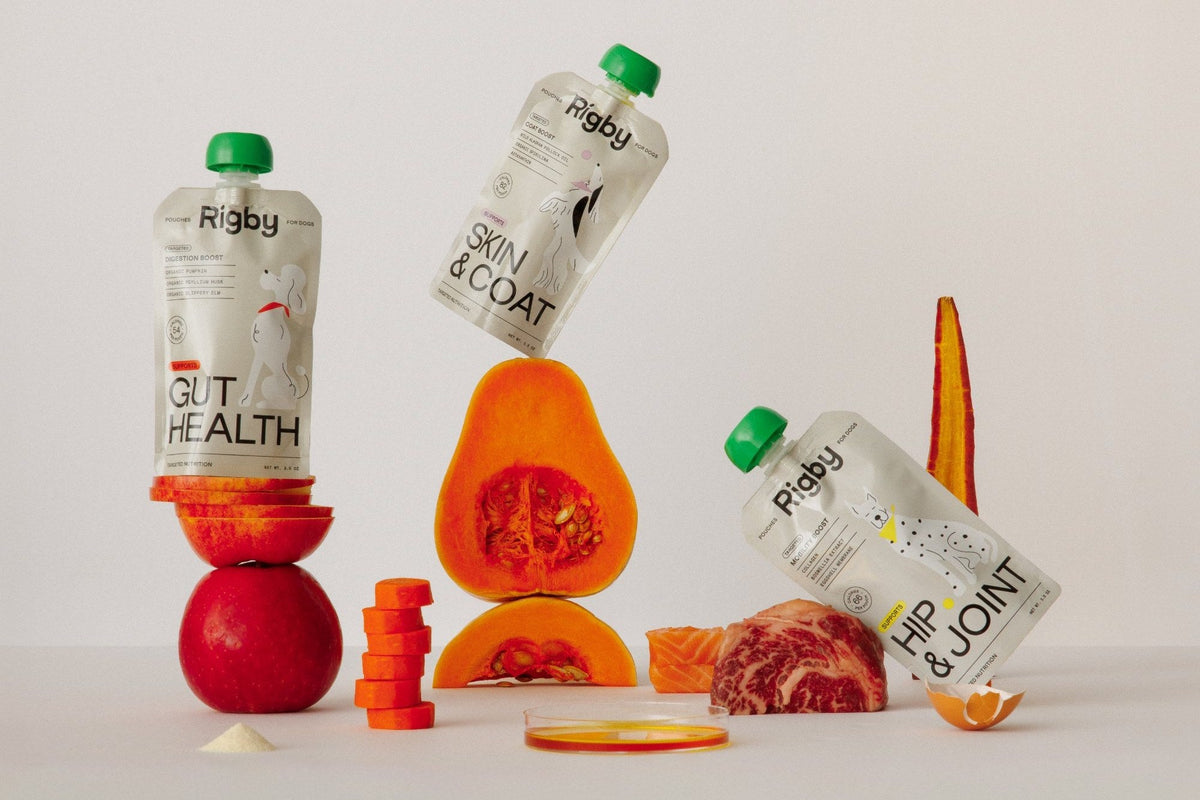
Want the dog's bowl to do a bit more? Rigby Targeted Pouches are made the same way, with ingredients chosen to support mobility, gut or coat.
So next time you're standing in front of that wall, read the front. Then turn it over.
Human food. Human standards. No compromise.
Human food, for the cat too
Essential Pouches
Five ingredients or fewer, printed in full.
Shop Pouches